How should I revise a chapter before a test?
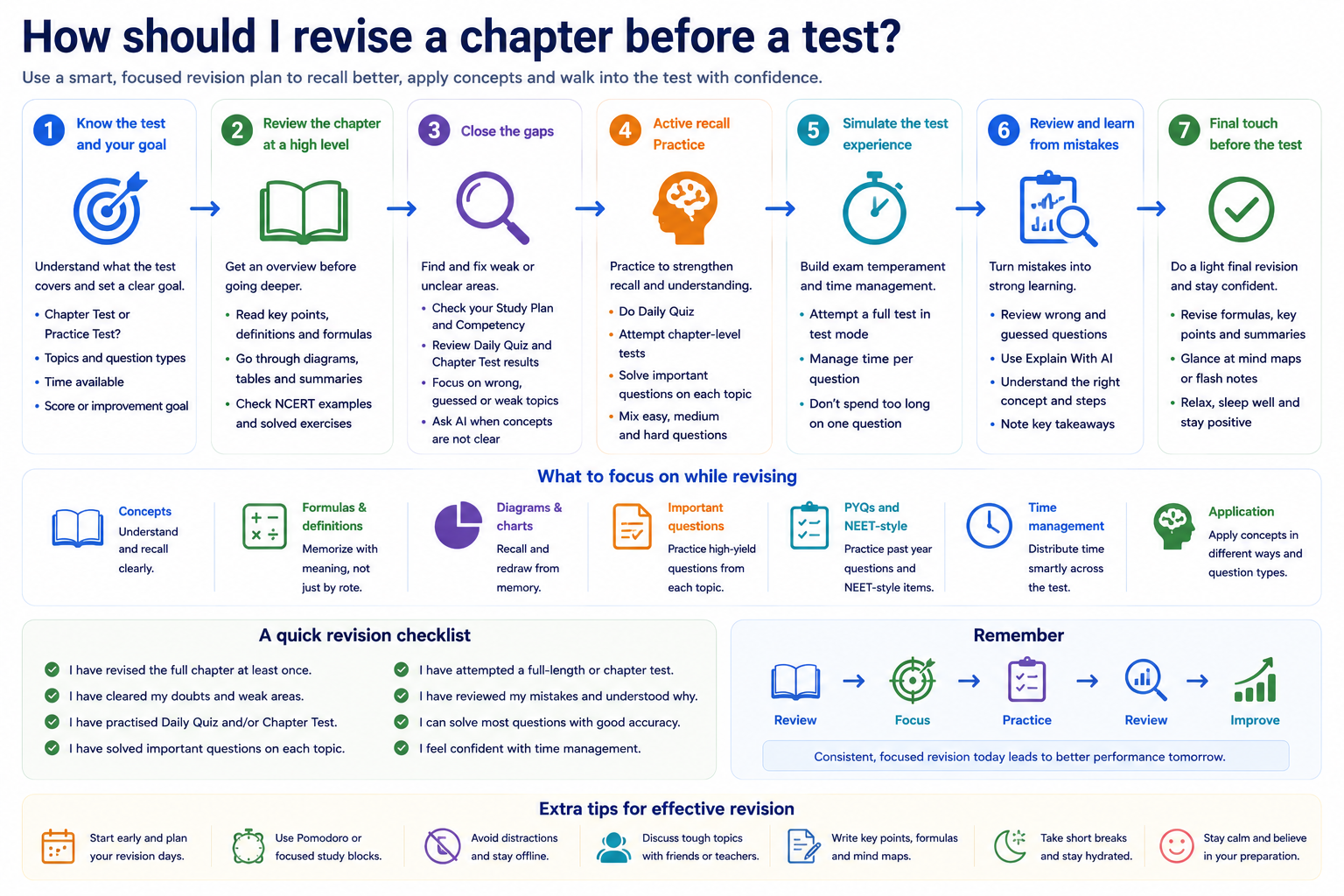
Good revision is not the same as reading the whole chapter again from the beginning.
Before a test, your time is usually better spent reminding yourself of the important ideas, finding what you are still unsure about, checking a few weak areas and making sure you can apply what you learned.
AIandMe gives you several ways to do that.
A useful revision pattern is:
See where you stand → revisit the important ideas → fix specific gaps → check yourself → review mistakes → go into the test knowing what still needs attention.
-
Start by deciding what you are preparing for
Before revising, be clear about the test ahead of you.
You may be preparing for:
- a school or CBSE assessment;
- an AI Study Room Chapter-level Test;
- a focused Practice With AI test;
- broader NEET practice;
- or another test outside AIandMe.
The chapter does not change, but the kind of revision you need may.
For a school test, you may want to revisit the chapter more broadly.
For NEET practice, you may also want to think about application, past-question patterns, speed and accuracy.
Start with the purpose of the test rather than trying to use every AIandMe feature.
-
Check what you have actually completed
Open the chapter and look at your Study Plan.
Check which learning days are:
- NS — not started;
- WIP — in progress;
- Done — completed.
If important learning is unfinished, finish it first instead of treating it as revision.
Remember that chapter progress reflects the Study Plan days you have completed. It does not tell you by itself how well you understand everything in the chapter.
-
Use Revise for a quick return to the important ideas
When you have already learned a section, Revise is designed for returning to it without working through all the detailed content again.
Depending on what is available in the section, Revise can bring together:
- the section overview;
- Key Points;
- Key Concepts;
- Try It prompts;
- and available videos or other learning media.
Revise helps you review; it does not complete a Study Plan day or change your Competency by itself. Try It prompts are not scored assessments.
Use this to remind yourself:
“What are the important ideas I should still be able to explain?”
Do not spend the same time on every concept. Move on from what is clear and spend more time where you hesitate.
-
Use Read when a quick revision is not enough
Sometimes revision exposes a concept that you no longer understand properly.
That is when Read becomes more useful than repeatedly scanning Key Points.
Go back to the fuller learning material when:
- you cannot explain why something happens;
- you have forgotten the reasoning;
- two concepts are getting mixed up;
- or a summary reminds you of the topic but not enough to solve a question.
When revision reveals a gap, fix it instead of reading the summary again.
-
Ask AI about the exact thing you are unsure about
You do not have to reread a whole section because of one doubt.
Use Ask AI when you can identify the specific part that is still unclear.
For example:
- “Can you explain the difference between these two ideas?”
- “I remember the formula but not why it works. Can you explain that?”
- “What is the easiest way to remember how these processes differ?”
- “I keep getting this type of question wrong. Which concept am I probably confusing?”
Because Ask AI works inside AI Study Room, it can use the current chapter and relevant section context.
Use it to remove a specific obstacle, then continue revising.
-
Review what your earlier checked work already told you
Before creating more questions, look at what your earlier work already showed you.
Inside AI Study Room, Past Practice Results lets you review earlier Daily Quiz and Chapter-level Test attempts and the available feedback.
Ask:
- Which questions did I struggle with?
- Which learning day had a weaker result?
- Did the feedback point to something I should study again?
- Is there a pattern I ignored after the earlier attempt?
A previous mistake can guide your revision, so you do not always need a new test to find what needs work.
-
Check the chapter when you want evidence before the real test
If you want a broader check of the chapter, use a Chapter-level Test in AI Study Room.
A Chapter-level Test checks across the whole chapter and contributes to chapter competency.
It does not mark Study Plan days Done or directly increase Study Plan progress.
Use it when you want to ask:
“After revising, how well can I currently handle the chapter as a whole?”
One result cannot prove that the chapter is mastered—or permanently weak.
Use the result to choose what deserves one more look.
-
For NEET revision, add question practice deliberately
If you are preparing for NEET and your plan includes the relevant access, Practice With AI can add another layer of revision.
You might use:
- a NEET PYQ test to practise previous-year questions currently available for the chapter or sections;
- an AI-generated test for fresh questions;
- or a Revision test to revisit eligible questions you previously answered incorrectly or marked Guessed.
Choose based on the question you are trying to answer.
Do I want to see how NEET has tested this chapter before? Use available PYQs.
Do I want to know whether I can handle a fresh question? Use AI-generated practice.
Do I want to revisit mistakes I have already made? Use a Revision test.
Do not create a large test simply because more questions feel like more revision.
-
Use past NEET patterns to decide where extra revision time may help
For supported Physics, Chemistry and Biology chapters, NEET Question Insights can show how relevant syllabus items and past NEET questions connect to the chapter and its sections.
If your revision time is limited, you can use this information to ask:
- Which sections have appeared more often in the available past questions?
- Is an important historical area also one of my weaker areas?
- Which section might deserve an extra round of revision?
Use this for additional focus, not syllabus exclusion.
Historical importance does not predict the next NEET paper, and a lower-frequency section is not something you can safely ignore.
-
Review wrong, Guessed and pacing problems before taking another broad test
If you have Practice With AI history, Testing Insights can help you find questions and patterns that deserve another look.
Once you have enough Practice With AI work for useful patterns to show, that can include:
- incorrect questions;
- Guessed questions;
- weaker chapters or sections;
- accuracy;
- and pacing.
Just before a test, this can be more useful than blindly practising another large set of questions.
Ask:
What mistake am I most likely to repeat?
If you repeatedly rush a certain type of question, remind yourself to slow down.
If one concept keeps producing Guessed answers, revisit it.
If one section repeatedly causes wrong answers, focus there.
Revision becomes more useful when it responds to your own results.
-
Match the revision to the time you actually have
You do not need the same revision plan every time.
If you have a short revision window
Focus on:
Revise → Key Points → difficult Key Concepts → one or two specific doubts
Do not try to relearn an entire chapter in a few minutes.
If you have more time
You might use:
Revise → fix gaps with Read/Ask AI → review earlier results → focused questions
If you have a longer preparation session
You might add:
Chapter-level Test or focused Practice With AI → review result → return to weak areas
The time you have should change the size of the revision—not the quality of your thinking.
-
Stop revising long enough to recognise what you already know
Revision can become inefficient when you keep rereading things that are already clear because they feel comfortable.
As you work through the chapter, separate ideas into three simple groups:
I know this well Move on.
I mostly know this, but I hesitate Give it a quick check.
I still don't understand or cannot apply this Spend your revision time here.
AIandMe does not need to make those three lists for you.
Use what your learning, quizzes, tests and practice are showing to make that judgement yourself.
Build a practical pre-test revision routine
A simple routine can be:
Check unfinished learning → Use Revise for the important ideas → Use Read or Ask AI for specific gaps → Review earlier mistakes → Check the chapter or practise targeted questions if useful → Review Wrong, Guessed or pacing problems → Give the remaining weak areas one final look
Then stop.
The goal of revision is not to touch every screen in AIandMe or reread every word in the chapter.
It is to go into the test knowing:
what you understand, what you have checked, and which few things needed your attention most.