How do I know my strengths and weaknesses?
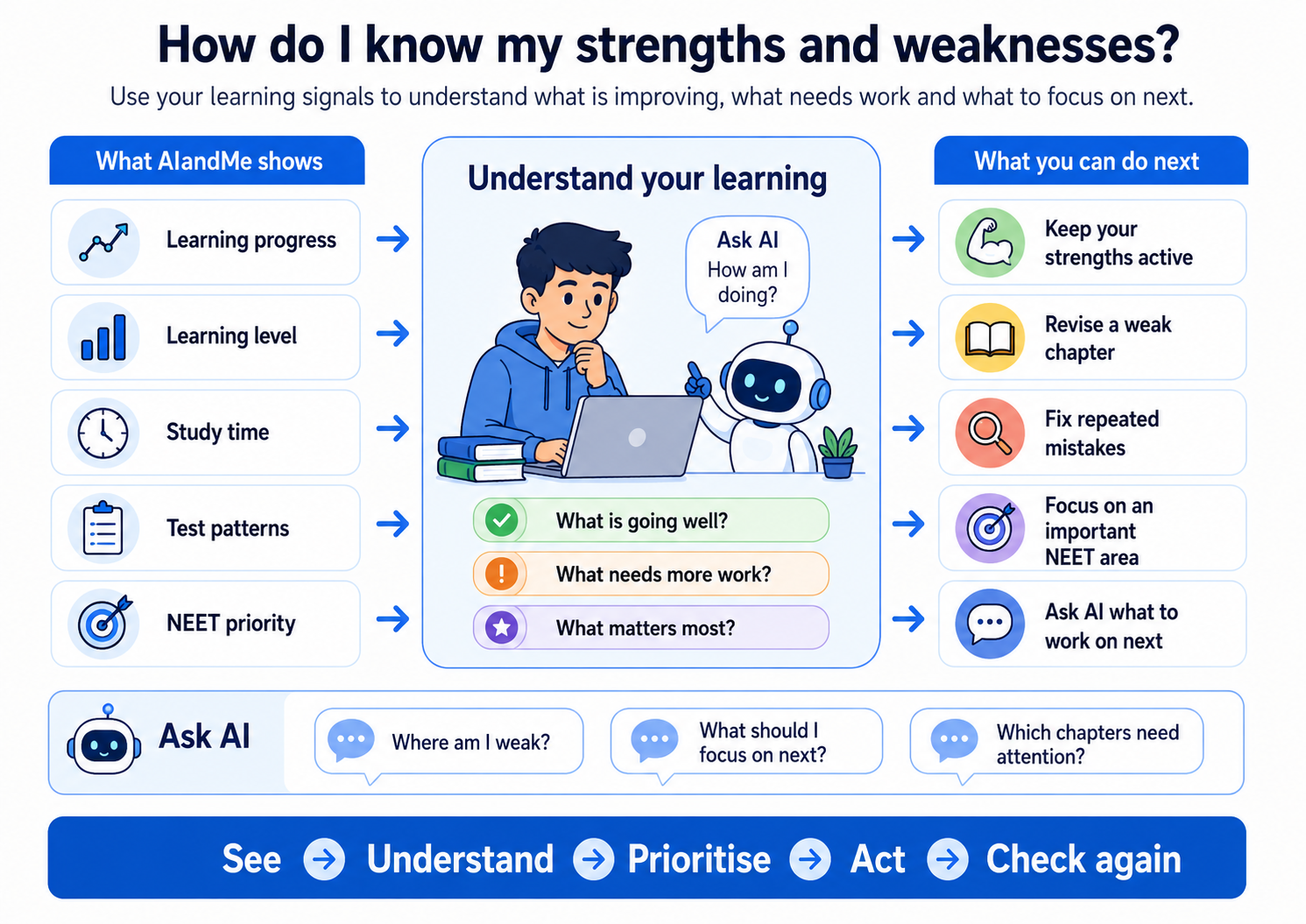
AIandMe gives you more than a score. Your learning progress, learning level, study time and test results can help you understand what is going well and where you may need more work.
Do not judge yourself from one test score or one number. Look for patterns across your learning and practice, then choose one thing to work on next. Your progress is not just a score. Use AIandMe to understand what is improving, what still needs work and what you can do next.
-
Start with the big picture
Begin with Learning Insights. Look at Subject Progress, Chapter Progress, Chapters Completed, Total Study Time and Overall learning level.
These signals answer different questions:
- Progress: How much have I worked through?
- Learning level: What does my evaluated learning currently suggest about my understanding?
- Study time: How much time have I invested?
No single signal tells the whole story. Look at progress, learning level and study time together.
AIandMe needs learning and practice activity before meaningful patterns can appear. If you have only just started or completed very few assessments, some insights may be empty or limited. Continue learning and practising, then check again later.
-
Notice what is going well
Strengths matter too. Look for subjects where your learning level is stronger, chapters where progress and understanding are improving, movement in Learning level over time, and recent assessment results that are getting better.
Ask yourself, "What has improved?" A strength can show that your current way of learning is working. Keep those areas active while you work on weaker areas; do not abandon a strong topic completely.
-
Find where you need more work
Use Weakest chapters, the subject summary, recent assessments, learning level, progress and study time to find areas that may need attention.
A chapter may appear weak for different reasons:
- you have barely started it;
- progress is still low;
- your evaluated learning level is still developing;
- recent quizzes or chapter tests show difficulty; or
- substantial study time has not yet led to stronger understanding.
A weak chapter is not a failure. If you have spent a lot of time on a chapter but your understanding is not improving, more time alone may not be the answer. Change how you study it: revisit the difficult concept, use Revise or Read, clarify the doubt, practise, and then check your understanding again.
-
Look for patterns in your tests
Open Testing Insights and look beyond one result. One wrong answer can be a mistake. The same weakness appearing again and again is a pattern. Patterns tell you what to work on.
Where you have several completed tests, look for:
- whether your scores are improving;
- a subject with lower accuracy;
- chapters needing attention;
- concepts or sections needing focus;
- repeated incorrect or guessed questions;
- unattempted questions; and
- answer pacing where it is relevant.
Do not judge yourself by an isolated test. Review the evidence across several completed tests where available. Use Practice Tests to understand the Daily Quiz and Chapter-level Test activities that contribute evaluated results.
-
For NEET, combine weakness with importance
For students with NEET Stats available, combine your learning evidence with the visible preparation-priority information. Look at chapter importance, PYQ information, progress, learning level, study time and the Attention status.
Weakness and importance are not the same thing. A weak chapter may need work, but a chapter that is both weak and important for your NEET preparation may deserve earlier attention. Do not choose what to revise only because it is weak; also consider how important the chapter is for your preparation.
Past PYQ information does not predict what will appear in your next exam, and a lower-importance chapter should not be skipped.
Mentor AI NEET Insight can give you a concise review of your recent practice, tests and chapter work when it is available and enough information has been gathered.
-
Ask AI to help you understand the picture
You do not have to interpret every signal alone. Ask AI can use the learning and performance information available in AIandMe to help you understand your progress. When richer NEET Mentor AI guidance is available, it can also help you think about preparation priorities and next steps.
Try asking:
- "How am I doing overall?"
- "Where am I weak?"
- "What are my stronger areas?"
- "Which chapters should I work on next?"
- "What have I improved recently?"
- "Which subject needs more attention?"
- "I have two hours today. What should I focus on?"
If you are preparing for NEET, you can also ask:
- "Which important NEET chapters need my attention?"
- "What should I focus on this week?"
- "Am I balancing Physics, Chemistry and Biology?"
- "Which weak chapter should I work on first for NEET?"
Answers depend on the learning and practice information available. Early in your learning journey, there may not yet be enough evidence for a clear conclusion.
-
Turn one insight into one action
Do not stop at looking at insights. Choose one manageable next action:
- Weak chapter: return to AI Study Room and use Revise or Read.
- Repeated weak section: work specifically on that section.
- Repeated wrong or guessed questions: review those questions and practise similar ones.
- Important NEET chapter not yet started: start that chapter.
- Slow answer pacing: practise answering with appropriate time pressure.
- High study time but low learning level: change your learning method instead of simply adding more hours.
More time is not always the answer. The useful next step may be to clarify a concept, try another explanation, practise, review mistakes or change how you study.
-
Come back and look for change
After more learning and practice, return to Learning Insights and, where applicable, Testing Insights and NEET Stats. Look again and ask:
- Did the weak chapter improve?
- Is learning level moving?
- Are repeated mistakes reducing?
- Is subject accuracy improving?
- Is pacing improving?
- Has the priority chapter moved forward?
Ask AI again if it would help. The goal is not to label yourself permanently as strong or weak. Strengths and weaknesses change as you learn.
See → Understand → Prioritise → Act → Check again
Use your insights to choose the next useful action, then come back later and see what changed.